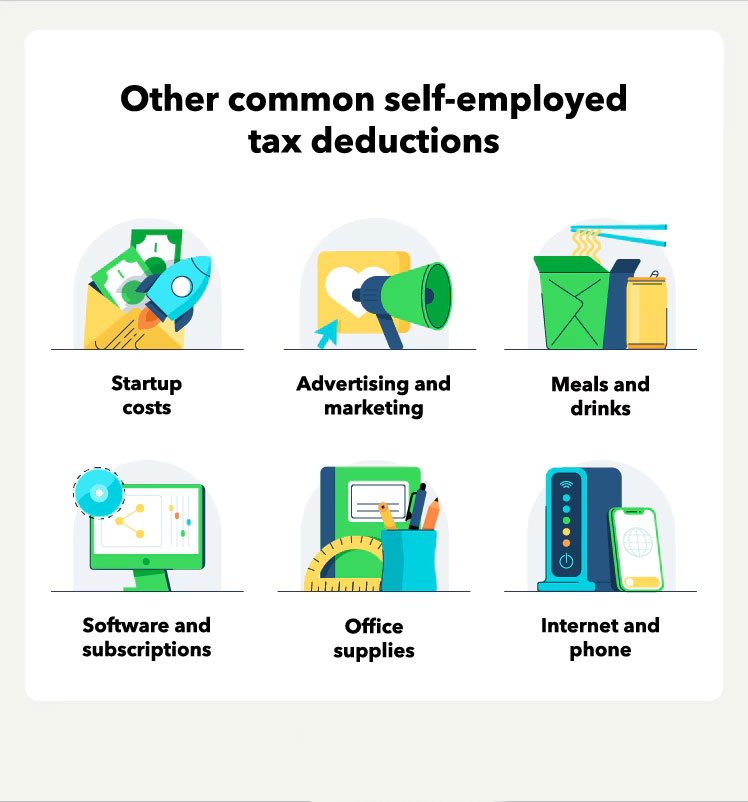
Working for yourself comes with freedom — and with a bigger tax responsibility. Freelancers, contractors, and small business owners usually pay both income tax and self-employment tax, and no employer is withholding money from each payment. The good news is that the self-employed can also deduct many legitimate business expenses, which can significantly reduce the tax you owe.
Yet many freelancers miss deductions they’re entitled to, simply because they don’t know about them or don’t keep good records. This guide covers the most commonly overlooked deductions for self-employed people in the United States.
The Basic Rule: Ordinary and Necessary
In general, the IRS allows you to deduct business expenses that are both:
- Ordinary: Common and accepted in your line of work.
- Necessary: Helpful and appropriate for your business.
Personal expenses aren’t deductible. If something is used for both business and personal purposes, you can usually deduct only the business portion. Most freelancers report business income and expenses on Schedule C.
1. Half of Your Self-Employment Tax
Self-employed people pay self-employment tax to cover Social Security and Medicare — both the employee and employer portions. The combined rate is 15.3% on net earnings (with the Social Security portion applying only up to an annual wage base).
The good news: you can deduct half of your self-employment tax when calculating your adjusted gross income. Tax software usually handles this automatically, but it’s important to understand why your taxable income is lower than you might expect.
2. Home Office Deduction
If you use part of your home regularly and exclusively for business, you may qualify for the home office deduction. A desk in a spare room used only for work can qualify; a kitchen table used for family dinners usually cannot.
There are two methods:
- Simplified method: Deduct a set rate per square foot of office space, up to a maximum area. Easy to calculate with minimal records.
- Regular method: Deduct the business percentage of actual home expenses, such as rent or mortgage interest, utilities, insurance, and repairs. More paperwork, but it can produce a bigger deduction.
3. Internet and Phone Bills
If you use your phone and internet for work, you can deduct the business-use percentage. For example, if 60% of your internet use is for work, you may deduct 60% of the bill. Keep a reasonable record of how you calculated the percentage.

4. Health Insurance Premiums
Self-employed people who pay for their own health insurance may be able to deduct premiums for themselves, their spouse, and their dependents — as long as they weren’t eligible for an employer-subsidized plan through their own or a spouse’s job. This deduction reduces your adjusted gross income even if you don’t itemize. To understand your plan’s costs, see health insurance deductibles, copays, and out-of-pocket maximums explained.
5. Retirement Contributions
Saving for retirement can also lower your tax bill. Popular options for the self-employed include:
- SEP IRA: Simple to set up, with high contribution limits based on a percentage of net earnings.
- Solo 401(k): Lets you contribute as both “employee” and “employer,” often allowing higher contributions at lower income levels. Some offer a Roth option.
- Traditional IRA: Contributions may be deductible depending on your circumstances. See Roth IRA vs Traditional IRA.
6. Software, Subscriptions, and Tools
Many freelancers forget about the small monthly costs that add up over a year, such as:
- Design, writing, or accounting software
- Cloud storage and backup services
- Website hosting and domain names
- Professional subscriptions and industry publications
- Project management and communication tools
7. Equipment and Computers
Laptops, monitors, cameras, office furniture, and other equipment used for your business can often be deducted. Depending on the item and cost, you may be able to deduct it in full in the year you buy it, or depreciate it over several years. Items used for both personal and business purposes are deductible only for the business-use portion.
8. Business Travel and Vehicle Use
Vehicle expenses
If you drive for business — for example, to meet clients — you can deduct vehicle costs using either:
- The standard mileage rate, set by the IRS each year, multiplied by business miles driven.
- Actual expenses, such as fuel, maintenance, insurance, and depreciation, multiplied by the business-use percentage.
Commuting from home to a regular workplace generally isn’t deductible. Keep a mileage log with dates, destinations, and purposes.

Travel
Business trips away from home can include deductible airfare, lodging, and a portion of meals. The trip’s primary purpose must be business.
9. Business Meals
Meals with clients or business associates are often 50% deductible when there’s a clear business purpose. Keep receipts and note who you met with and what you discussed.
10. Education and Professional Development
Courses, workshops, books, and conferences that maintain or improve skills in your current business may be deductible. Training for an entirely new career generally isn’t.
11. Marketing and Advertising
Costs to promote your business are usually deductible, including:
- Online ads and social media promotion
- Business cards and printed materials
- Website design
- Portfolio platform fees
If you run ads, our guide to digital marketing strategies can help you get more from your budget.
12. Platform and Payment Fees
Freelancers often lose a percentage of every payment to marketplace fees and payment processors. Service fees charged by freelance platforms and payment processing fees are generally deductible business expenses. Check your platform’s annual earnings statement to find the total.
13. Professional Services
Fees paid to accountants, tax preparers, lawyers, and business consultants for business purposes are usually deductible.
14. Business Insurance
Premiums for professional liability, general liability, or equipment insurance related to your business may be deductible.
15. The Qualified Business Income (QBI) Deduction
Many self-employed people may qualify for the QBI deduction, which can allow eligible taxpayers to deduct a portion of their qualified business income. Income limits and rules for certain service businesses apply, so check the current rules or ask a tax professional.
Quick Reference Table
| Deduction | Commonly missed because… |
|---|---|
| Half of self-employment tax | People don’t realize it’s deductible |
| Home office | People fear it’s an audit risk or think it’s too complex |
| Phone and internet | Business-use share isn’t tracked |
| Health insurance premiums | Not known to be available without itemizing |
| Retirement contributions | SEP IRA and Solo 401(k) aren’t well known |
| Software and subscriptions | Small monthly charges are forgotten |
| Platform and payment fees | Fees are deducted before payment arrives |
| Mileage | No mileage log is kept |
Don’t Forget Quarterly Estimated Taxes
Because no one withholds tax from your freelance income, you’re generally expected to pay estimated taxes quarterly if you expect to owe a certain amount for the year. Missing these payments can lead to penalties. Many freelancers set aside a percentage of every payment in a separate savings account for taxes. A high-yield savings account is a good place to keep this money until it’s due.
Record-Keeping Tips
- Open a separate business bank account to keep business and personal spending apart.
- Save receipts digitally using an app or cloud folder.
- Track mileage with an app or a simple log.
- Record business purposes for meals and travel.
- Use accounting software to categorize expenses throughout the year — see our accounting software comparison.
- Keep records for several years in case of questions from the IRS.
Frequently Asked Questions
Does claiming the home office deduction increase my audit risk?
If you qualify and keep proper records, you’re entitled to claim it. The key is meeting the regular and exclusive use requirements.
Can I deduct my personal clothing?
Generally, no. Clothing is deductible only if it’s required for work and not suitable for everyday wear, such as uniforms or protective gear.
Do I need receipts for every expense?
Good records are essential. Keep receipts, invoices, bank statements, and notes that show the amount, date, and business purpose of each expense.
I’m a freelancer outside the U.S. — does this apply to me?
No. This guide covers U.S. federal rules. Many countries allow similar business expense deductions, but the details differ, so check with a local tax professional. For freelancers earning from international platforms, our guides to earning money online as a writer and online jobs in Pakistan cover getting started.
Final Thoughts
Freelancers can legally reduce their taxes by claiming all the business deductions they qualify for — from half of self-employment tax and the home office deduction to software subscriptions, platform fees, and retirement contributions. The key is good record-keeping throughout the year, not a scramble in April.
Because tax rules and limits change every year, consider working with a qualified tax professional, especially as your freelance income grows.
This article is for general educational purposes and is not tax advice. Tax laws change frequently, so consult the IRS or a qualified tax professional about your situation.